The Balanced Food Pyramid for Kids: ICMR-NIN Daily Servings & Diet Chart

Key Takeaways
The balanced food pyramid focuses on food groups instead of food fears. All grains, millets, fruits, vegetables, dairy products, proteins, nuts, seeds, and healthy fats should be included. Sugary and packaged foods should be limited.
- The best diet supports all your child's needs, including healthy growth, digestion, and immune function, as well as a focus on play and study. It should also include age-appropriate, locally available foods. Pediatricians should be consulted if there are any concerns about growth.
Planning a child’s daily meals can be exhausting. More so, with the contrasting advice that parents receive. One parent might say to add more milk, while another says to cut out the carbs. Social media complicates things even more with constant new rules. This guide simplifies the food pyramid for children using the ICMR-NIN 2024 Indian dietary framework. This guide will describe food groups, serving sizes, portion sizes, and meal ideas for children aged 2-18 years.
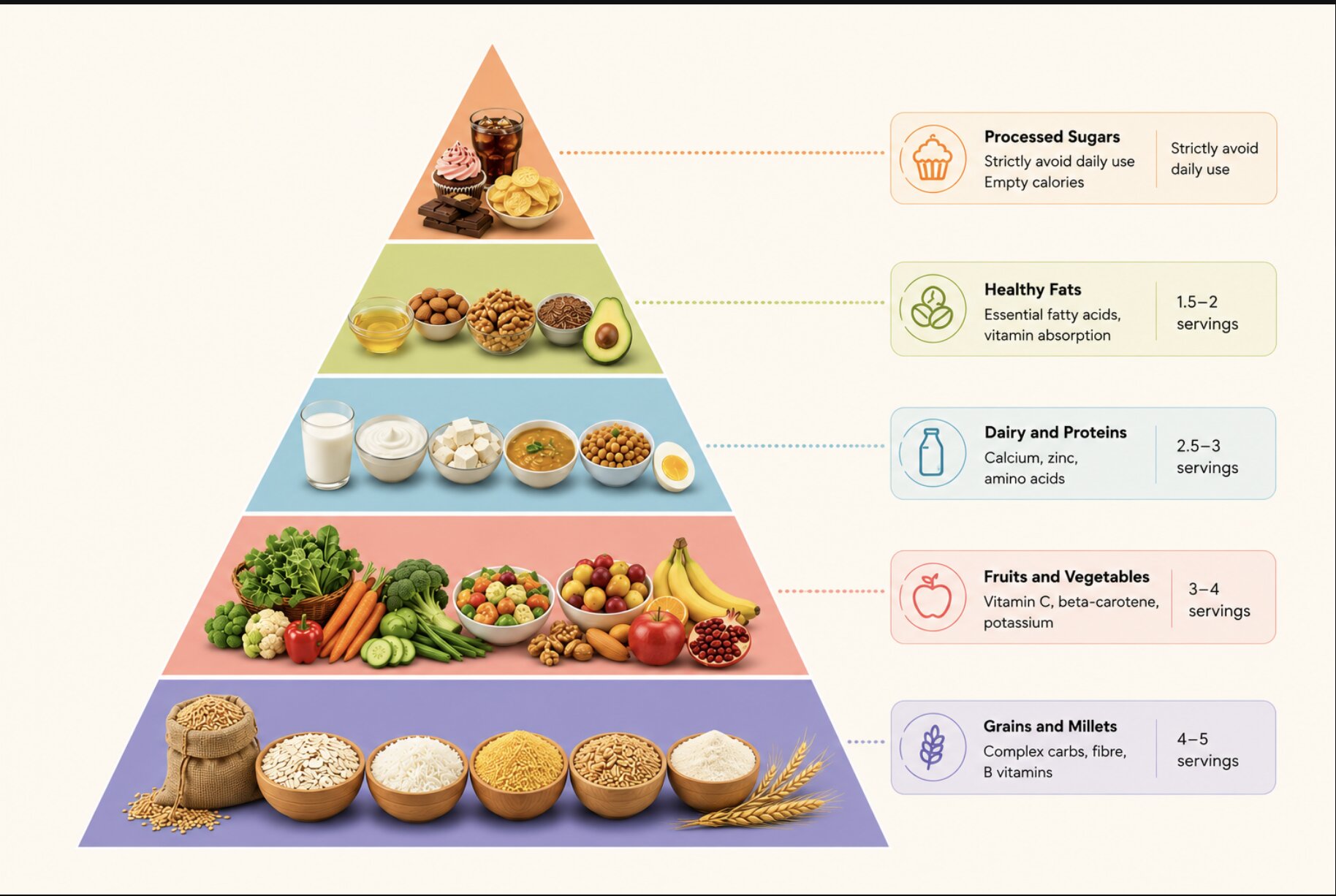
The balanced kids’ food pyramid is a simple guide that classifies food groups and specifies how often children should eat each group. Whole grains and millets form the base. Fruits and vegetables are next. Dairy and protein foods are for growing bones and muscles, so these are next. Nuts, seeds, and healthy fats come in small amounts. Ultra-processed foods and sugary snacks come last. These should be eaten as little as possible because they are full of calories and low in nutrients.
Why the Food Pyramid Matters for Child Growth
Food is essential to support the rapidly growing bodies of children. And to provide a steady supply of energy, protein, vitamins, and minerals, picking the right meal is vital. The food pyramid helps plan meals to optimize development by simply showing how to fill a plate.
Fueling Rapid Cellular and Bone Development
Children don’t need healthy foods in general, but a variety of healthy foods provides a balanced mix of food groups.
Carbohydrates present in grain and millet products provide the energy required for school and extracurricular activities. The proteins present in dals, eggs, dairy products, paneer, fish, and meat assist in the growth and repair of body tissues. To help develop strong bones and teeth, calcium and vitamin D are required.
According to the WHO growth standards, a child’s growth can be assessed by measuring height, weight, and BMI. Hence, the assessment of a child’s growth underscores the importance of the quality of the food. A child can consume sufficient calories but can lack adequate nutrition.
Preventing the Dual Burden of Malnutrition
India is facing two nutrition challenges simultaneously. India is facing two nutrition challenges simultaneously. The first is inadequate nutrition. The second is excessive consumption of processed foods, leading to excess calories.
The NFHS-5 reported that malnutrition remains prevalent among children. It’s seen as stunting, wasting, and underweight, which were present in 35.5%, 19.3%, and 32.1% of children under the age of five, respectively. The report also stated that 67.1% of children aged between six months and five years were anemic. Simultaneously, pediatric obesity is on the rise.
Combining a food pyramid with a nutrition scale reduces the risks of both hidden hunger and excess unhealthy foods.
The 5 Essential Food Pyramid Layers Explained
The Foundation: Whole Grains, Cereals and Millets
Verdict: Provides steady energy and B vitamins for stamina and daily activity.
Key Nutrient: Complex carbohydrates and fibre
ICMR Target: 4-5 daily servings
Ideal Sources: Brown rice, whole wheat, ragi, jowar, bajra, oats, dalia
Whole grains, cereals, and millets form the base of the Food Pyramid. Providing energy for daily activity is especially important for a developing child. It is also important for a child’s growing brain to have adequate glucose. Whole Grains provide this in a steady and safe form.
These foods are all good examples: chapati, rice, ragi porridge, jowar roti, bajra khichdi, oats, idli, poha, and dalia. Including millets is a good way to increase food variety. Ragi is a good source of calcium. Bajra and jowar are good sources of fiber and minerals.
In ICMR-NIN’s “My Plate for the Day”, cereals and nutri-cereals are included as a major food group. However, it is also shown that grains should not fill the entire plate. Pulses, vegetables, fruits, dairy, nuts, and fats are also essential for children.
Do not make maida the main grain. Foods like white bread, noodles, biscuits, and bakery snacks digest quickly. They also do not contain fiber like whole grains. While they may fill the stomach, they may not meet nutritional requirements.
The rule is pretty clear. Stick to the grains you normally use, but improve. Prefer whole wheat to maida. Instead of a plain dosa, use a millet dosa. Dal can also be added to rice. Also, add vegetables to upma or poha.
Best For: Growing children across all age groups who need physical and academic energy.
The Vital Core: Fruits and Micronutrient-Dense Vegetables
Verdict: Supplies vitamins, minerals, fibre, and antioxidants for immunity.
Key Nutrient: Vitamin A, vitamin C, folate, potassium, and fibre
ICMR Target: 3-4 daily servings
Ideal Sources: Spinach, moringa leaves, carrots, pumpkin, beans, citrus fruits, banana, papaya
Fruits and vegetables layer two. They help address some micronutrient gaps and support digestion and immunity.
In the ICMR-NIN plate model, fruits and vegetables account for a significant share of the daily diet. It suggests having more vegetables than fruits. Reasons for such a recommendation can be attributed to the Indian meal pattern. Vegetables are a common accompaniment to most dishes.
The inclusion of dark green leafy vegetables such as spinach, amaranth, moringa leaves, methi, and bathua provides additional Iron, folate, and magnesium. Carrots, pumpkins, and papaya are sources of beta-carotene. Vitamin C is found in citrus fruits. Vitamin C also enhances the absorption of non-heme iron in plant foods.
Studies show that low dietary diversity is associated with an increased risk of micronutrient deficiency in children. This is why a variety of colors is essential. A plate with green, orange, red, yellow, and white foods offers a larger variety of nutrients.
Whole fruits are always better than fruit juices. Much fiber is lost in the juice. Sugar intake can also be significantly greater. A whole fruit (orange, guava, banana, apple, or papaya) is more satiating.
Suggestion for fussy eaters: start small. Grate some carrot and add it to the paratha. Add some palak to the dal. Add some pumpkin to the khichdi. Put some cucumber sticks with curd dip. Keep some fruits visible and ready at home.
Best For: Preschoolers and school-age children who need stronger micronutrient coverage.
The Structural Builders: Bioavailable Proteins and Cultured Dairy
Verdict: Supports muscles, bones, enzymes, hormones, and tissue repair.
Key Nutrient: Protein, calcium, zinc, vitamin B12, and essential amino acids
ICMR Target: 2.5–3 daily servings
Ideal Sources: Milk, curd, paneer, dal, rajma, chana, soybean, eggs, fish, chicken
Protein and dairy form the structural layer of the pyramid. This layer is especially important during childhood and even more important during puberty.
Protein is key in making and repairing bodily tissues. Its role is critical to the function of hormones and the immune system. Active children who are developing may require more careful distribution of protein throughout the day.
The potential to provide adequate protein in well-planned Indian vegetarian cuisine is high. The combination of rice and dal, roti and chana, dosa and sambar, and khichdi and curd are examples of positive combinations. Multiple legumes can facilitate the ideal protein combination.
Calcium and high-quality protein can also be found in dairy products. In addition to convenience, curd may also be more easily digested by younger children. Paneer can be used to make parathas, pulao, sandwiches, dhokla, or bhurji. Avoiding excess sugar can be a goal for porridge or kheer made with milk, and then enhancing it with fruit in a smoothie.
IAP guidance states that calcium and vitamin D are essential for healthy bones in children and adolescents. Indian children who are deficient in vitamin D should play outdoors. It will help in promoting healthy bones.
For those families that are not vegetarian, eggs, fish, and lean meats can be included. In addition to providing protein, these foods can provide vitamin B12. Avoiding the frying pan and instead boiling or making egg bhurji, fish curry, or chicken stew is a healthy tip.
Best For: Pre-teens and teenagers entering a period of rapid growth.
The Cellular Optimizers: Healthy Fats, Nuts and Cold-Pressed Oils
Verdict: Helps brain development, hormone function, and absorption of fat-soluble vitamins.
Key Nutrient: Essential fatty acids, vitamin E, omega-3 fats, zinc, and magnesium
ICMR Target: 1.5–2 daily servings
Ideal Sources: Groundnut oil, mustard oil, sesame oil, ghee, almonds, walnuts, peanuts, flaxseeds
Healthy fats are not the enemy. The most important part is to focus on appropriate portion sizes. Applying a small amount of ghee on dal or roti is acceptable, and a handful of soaked almonds or walnuts may be appropriate for a small snack. Traditional oils such as groundnut, mustard, and sesame may also be included.
Nuts and seeds are rich in beneficial minerals. Nuts and seeds are rich in beneficial minerals. Food items such as almonds, peanuts, and seeds like sesame and flax provide magnesium, zinc, and healthy fats. Plant-based omega-3s that come from walnuts and flaxseeds.
The ICMR-NIN 2024 guidelines have suggested that all oils and fats should be consumed in moderation. Additionally, they have recommended limiting foods high in sugar, salt, and fat, as well as ultra-processed foods. This is important to consider. For example, small amounts of homemade ghee are not comparable to store-bought cream biscuits or fried chips.
Trans fats should be avoided, and oil should not be reheated multiple times. Packaged foods, fried snacks, and bakery items typically contain low-quality fats. These foods may replace healthier foods in a diet.
For younger children, nuts should be served safely. Use powdered nuts, nut chutney, or seed powder if choking is a concern. Always consider allergies.
Best For: Toddlers and primary school children during brain and nervous system development.
The Restricted Apex: Refined Sugars and Ultra-Processed Snacks
Verdict: Adds empty calories and can displace nutrient-rich foods.
Key Nutrient: None significant
ICMR Target: Consume sparingly
Ideal Source: Minimize as much as possible
The apex of the food pyramid is narrowed intentionally. Items such as sugar-laden snacks, sodas, ready-to-drink packaged juices, cream biscuits, fried chips, instant noodles, and many bakery products should not be regular features of a daily diet.
The WHO recommends that no more than 10% of a person’s total energy intake come from free sugars. Sugars below 5% may be beneficial. This is important for children as free sugars are often consumed at the expense of milk, fruits, vegetables, and protein foods.
The ICMR-NIN 2024 guidelines, in addition to recommending the avoidance of ultra-processed foods, especially HFSS products, underscore their affordability and attractiveness. However, such foods generally lack sufficient amounts of fruits, vegetables, and other nutrient-dense foods, and are low in fiber.
Foods should not be banned completely, as this may increase their appeal. Instead, make them occasional. Serve them after a balanced meal. Avoid making them a reward.
A food pyramid-type home rule works better. Daily nibbling foods should come from real foods. These could be roasted makhana, fruit, curd, boiled chana, corn, peanuts, vegetable sandwiches, or homemade poha.
Best For: Highly restricted use across all pediatric age groups.
Quick Food Pyramid Serving Comparison
The table below provides a simple serving view for ages 6 to 11. For daily planning, use our verified balanced diet chart for kids to track macro proportions across meals easily.
| Pyramid Layer | Daily Servings (Ages 6-11) | Standard Serving Example | Primary Nutrient Target |
| Grains and Millets | 4-5 servings | 1 whole wheat chapati or 1/2 cup cooked ragi porridge | Complex carbs, fibre, B vitamins |
| Fruits and Vegetables | 3-4 servings | 1 cup cooked green vegetables or 1 medium seasonal fruit | Vitamin C, beta-carotene, potassium |
| Dairy and Proteins | 2.5-3 servings | 250 ml milk, 1 cup dal, curd, paneer, or egg | Calcium, zinc, amino acids |
| Healthy Fats | 1.5-2 servings | 1 teaspoon ghee or 5–6 soaked almonds | Essential fatty acids, vitamin absorption |
| Processed Sugars | Strictly avoid daily use | None. Limit to rare occasions. | Empty calories |
Age-Wise Nutritional Scaling for Indian Kids
The size of the pyramid’s segments does not change; the children’s ages merely alter the sizes of the portions.
Toddlers and Preschoolers (Ages 2-5 Years)
Small, developing bodies require smaller but more frequent meals. Frequent white, soft, easily chewable, and nutritious foods are best. Options such as Khichdi, Curd Rice, Dalia, Vegetable Upma, Soft Roti and Dal, mashed Paneer, and soft, small fruit pieces are good. Whole Milk can help, unless advised otherwise by a doctor.
School-Aged Children (Ages 6–11 Years)
Children in this age group spend a lot of energy at school and playing. Meals should be larger and more varied. Roti made with mixed millets, Vegetable Parathas, Dal with Rice, Sprouts, Curd, Eggs, Paneer and all seasonal Fruits should be included. Pack lunch boxes that can be eaten in fun, filling, healthy ways, instead of just filling them with biscuits and Bread Jam or Packaged Snacks.
Adolescents and Teenagers (Ages 12–18 Years)
Adolescents and teenagers experience rapid growth. Teenage girls should have more Iron. Teenage boys and girls should have more Protein and Calcium. Calcium requirements are higher in older children and adolescents, according to ICMR-NIN RDA data.
[Read our detailed guide to child nutrition to ensure Calcium and Protein needs are met.]
Actionable 7-Day Food Pyramid Meal Blueprint
We have curated a 7-day meal plan based on Harvard’s Healthy Eating Pyramid. You can use this as a flexible Indian meal chart. However, you may adjust portions to age, appetite, activity, and medical needs.
| Day | Breakfast | Mid-Morning | Lunch | Evening Snack | Dinner |
| Monday | Ragi uttapam with milk | Apple with walnuts | Rice, dal, carrot sabzi | Curd with makhana | Paneer chapati roll |
| Tuesday | Vegetable poha with peanuts | Banana | Roti, chana, salad | Sprouts chaat | Egg or paneer bhurji with roti |
| Wednesday | Dalia with milk and fruit | Guava | Khichdi with curd | Roasted chana | Vegetable pulao with dal |
| Thursday | Idli with sambar | Papaya | Roti, rajma, cucumber | Buttermilk and peanuts | Rice with fish curry or dal |
| Friday | Besan chilla with curd | Orange | Millet roti, dal, greens | Corn chaat | Paneer pulao with salad |
| Saturday | Oats porridge with nuts | Seasonal fruit | Rice, egg curry or soybean curry | Homemade lassi | Roti with mixed vegetables |
| Sunday | Paratha with curd | Fruit bowl | Dal rice with salad | Makhana and milk | Vegetable khichdi with ghee |





 No Refined Sugar
 No Preservatives
 No Maltodextrin