12 Best Calcium-Rich Foods for Babies

Key Takeaways
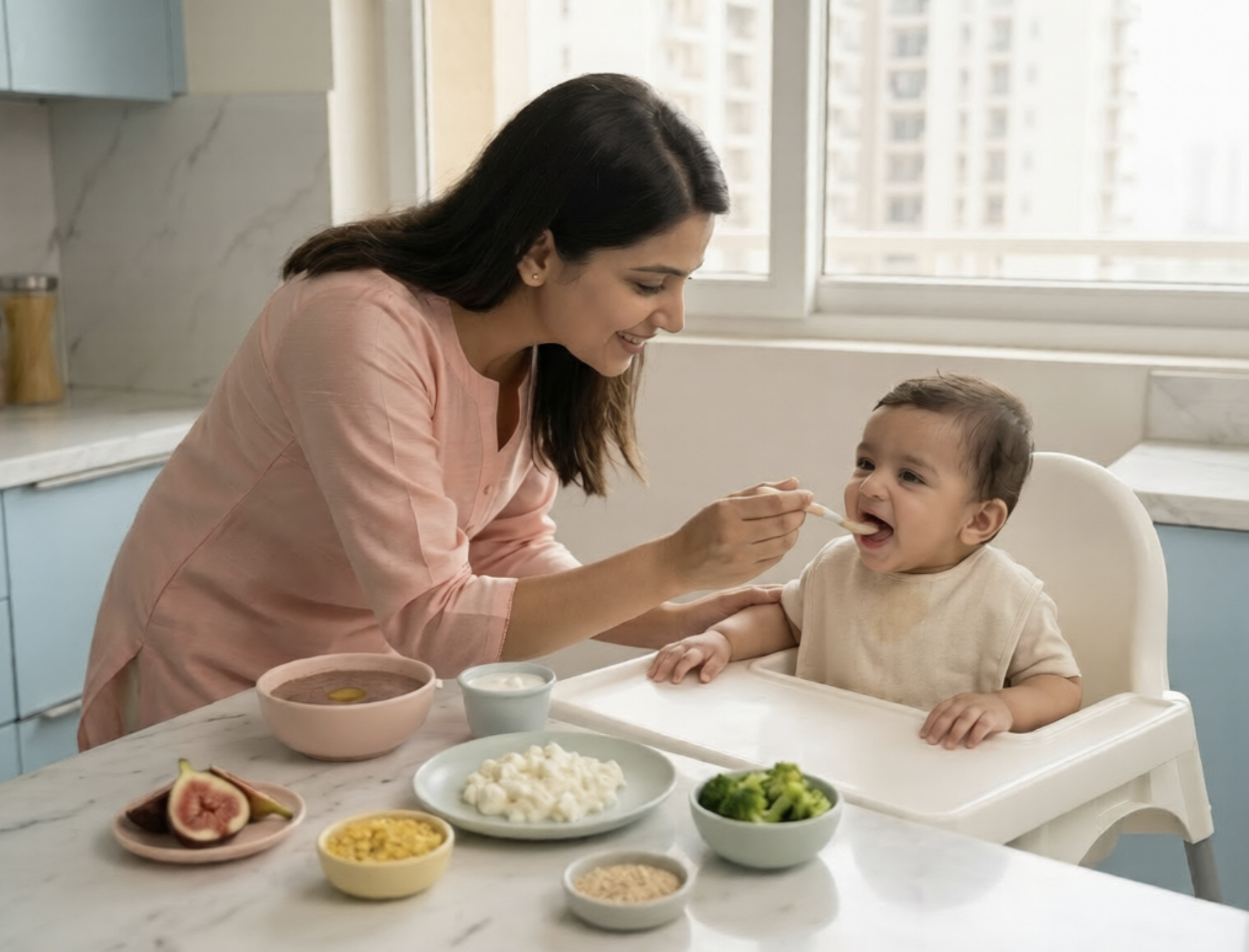
From 6 months, babies require age-staged calcium-rich foods, with daily needs rising from 260 mg to 700 mg for toddlers. Twelve safe Indian dairy and plant-based options—including dahi, paneer, ragi, and moringa—must be prepared as choke-safe mashes or purees. To ensure proper growth, these sources must be paired with Vitamin D, sprouted or soaked to maximize absorption, and introduced without cow’s milk before age one.
For 6 months, breast milk or formula supplies your baby’s main nutrition. Once solids begin, calcium-rich foods become important too. Parents need to know which foods are safe, when to introduce them, and how to prepare them. This guide covers 12 calcium-rich foods for babies from 6 months onwards, including dairy and dairy-free Indian options.
The safest early calcium-rich foods for babies include plain full-fat yoghurt from 6 months, ragi porridge from 6 months, and calcium-set tofu from 6–8 months. Paneer can usually be introduced around 8-9 months, in a soft, mashed form. Cow’s milk should not be given as a drink before 12 months. Babies aged 7-12 months need about 260 mg of calcium daily, while children aged 1-3 years need about 700 mg daily. Vitamin D is also essential because it helps the body absorb calcium.
Why Calcium Matters in the First Two Years
The initial two years of a child’s life constitute an especially rapid phase of growth. During this period, a child’s bones, teeth, and muscles grow. Calcium is an integral mineral for the formation and strengthening of this growth and for the signalling of nerves. And the gastrointestinal absorption of calcium is aided by vitamin D.
Deficiencies in calcium and vitamin D can result in inadequate bone mineralisation in children. And more severe deficiencies result in rickets. This disease is characterised by delayed skeletal growth, soft bones, and weakness. Rickets also delays tooth eruption and can lead to bowing of the legs.
How Much Calcium Do Babies Need?
| Age Group | Daily Calcium Need | Main Sources |
| 0-6 months | 200 mg/day | Breast milk or formula |
| 7-12 months | 260 mg/day | Breast milk/formula + solids |
| 1-3 years | 700 mg/day | Milk, yoghurt, paneer, ragi, tofu, greens, seeds |
These values are used across the board in paediatric references. The guidelines set by the Indian IAP also stipulate that calcium intake during infancy should be at least 200 mg/day. And it should be between 250 and 500 mg/day during the first year of life, when dietary intake is lower.
Vitamin D: The Absorption Partner
Calcium does not work alone. Vitamin D aids gastrointestinal absorption and utilisation of calcium. For this reason, IAP guidelines recommend 400 IU/day of vitamin D for children younger than 1 year. Because breast milk is deficient in vitamin D, paediatricians recommend supplementation.
12 Calcium-Rich Foods for Babies
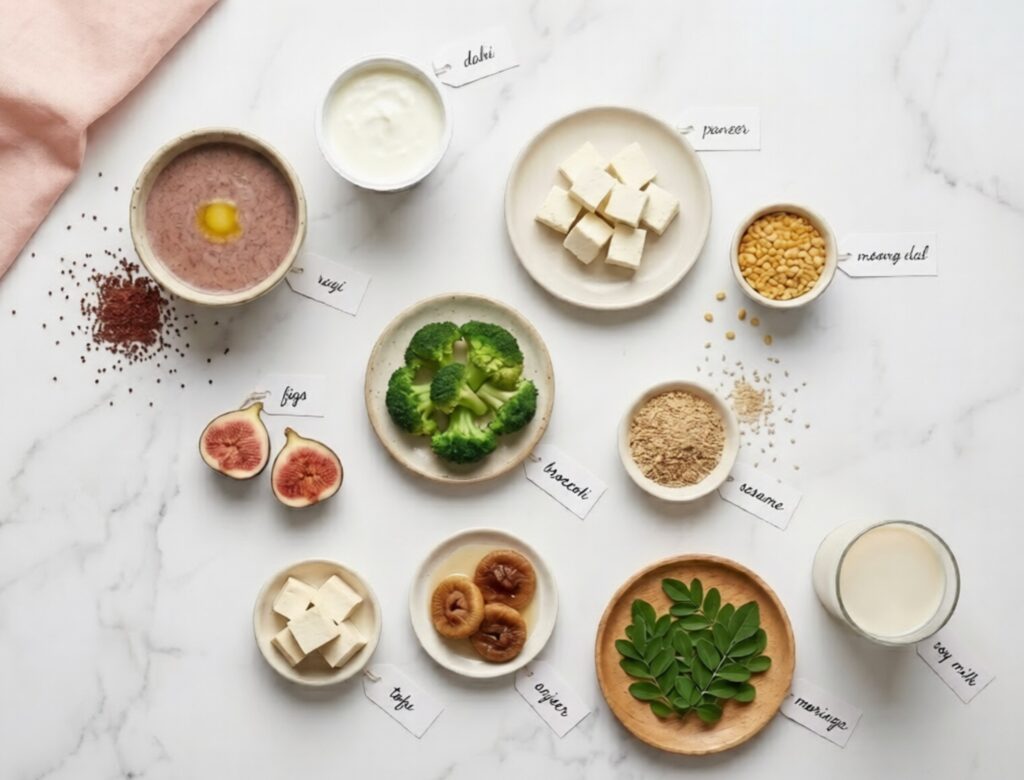
| Food | Calcium / Serving | Earliest Age | Dairy-Free | Indian Use |
| Yoghurt or dahi | ~140 mg / ½ cup | 6 months | No | Plain full-fat dahi |
| Paneer | ~200 mg / 100 g | 8-9 months | No | Mashed into khichdi |
| Ragi | ~344 mg / 100 g | 6 months | Yes | Ragi kanji |
| Calcium-set tofu | ~350 mg / ½ cup | 6-8 months | Yes | Pureed tofu |
| Moringa leaves | ~440 mg / 100 g | 8-9 months | Yes | Moringa dal |
| Ground sesame | ~90–100 mg/tsp | 10–12 months | Yes | Til paste |
| Amaranth | ~159 mg / 100 g | 8 months | Yes | Rajgira porridge |
| Sardines with bones | ~300–350 mg / 100 g | 8-10 months | Yes | Mashed with rice |
| Dal and lentils | ~20–60 mg / 100 g | 6 months | Yes | Moong dal |
| Broccoli | ~40 mg/ ½ cup | 7-8 months | Yes | Steamed puree |
| Figs | ~35–40 mg/fig | 10–12 months | Yes | Soaked anjeer |
| Fortified soy milk | ~300 mg/cup | 12 months+ | Yes | Cup feeding |
Yoghurt or Dahi: Earliest Age: 6 Months
Calcium per serving: Around 140 mg per ½ cup
Earliest safe age: 6 months
Preparation form: Plain, full-fat, unsweetened
Dairy-free: No
Dahi is an excellent starting dairy food for infants, as it is easy to consume, nutritious, and rich in calcium, protein, and probiotics. According to the USDA, plain whole milk yoghurt contains about 206 mg of calcium per 6 oz serving. Therefore, for infants, a serving of about ½ cup of yoghurt is recommended.
Pick a plain, whole milk yoghurt. Steer clear of flavoured, sweetened, and dessert yoghurts. Start with a couple of small spoons. Monitor the baby for gastrointestinal difficulties, rashes, or eczema. Especially if there is a family history of milk allergies.
Indian serving idea: Plain dahi with mashed banana.
2. Paneer: Earliest Age: 8-9 Months
Calcium per serving: Around 200 mg per 100 g
Earliest safe age: 8–9 months
Preparation form: Mashed, grated, or soft cubes
Dairy-free: No
Paneer is a great food source for developing lactational infants, as it contains protein, calcium, and fat. For healthcare practitioners working with young lactational infants, the recommendation is to use locally sourced, homemade paneer. It’s because it has less sodium than the processed alternatives.
It is also better to mash paneer into lighter foods. You may add it to dal, khichdi, or vegetable puree. Paneer has a high caloric density and providing large servings may lead to excess weight gain for young infants.
Indian serving idea: Soft paneer mashed into moong dal khichdi.
3. Ragi or Finger Millet: Earliest Age: 6 Months
Ca per serving: Around 344 mg per 100 g raw ragi
Earliest safe age: 6 months
Preparation form: Thin kanji or porridge
Dairy-free: Yes
Ragi, or finger millet, can be introduced as one of the earliest food sources to infants. It contains one of the highest concentrations of calcium. It has about 344 mg of calcium per 100 g, and it is also a great food source for baby-friendly porridge.
Whenever possible, use sprouted or fermented ragi flour. Ragi has phytic acid. Fermentation and germination help reduce phytic acid concentration and improve mineral bioavailability.
Indian serving idea: Sprouted ragi kanji with a small drop of ghee.
4. Calcium-Set Tofu: Earliest Age: 6–8 Months
Ca per serving: Around 350 mg per ½ cup, if calcium-set
Earliest safe age: 6–8 months
Preparation form: Silken tofu puree or mash
Dairy-free: Yes
Tofu is a great choice for babies who need a dairy alternative. However, only calcium-set tofu is high in calcium. Some tofu has much less calcium. So, look for calcium sulphate or calcium salts.
Begin with silken tofu, and mash or blend it to a puree. It is important to introduce tofu slowly, due to its status as a common allergen. After the introduction, keep an eye out for rashes, vomiting, or diarrhoea.Indian serving idea: Silken tofu blended into sweet potato puree.
5. Moringa Leaves or Drumstick Leaves: Earliest Age: 8–9 Months
Ca per serving: Around 440 mg per 100 g of leaves
Earliest safe age: 8–9 months
Preparation form: Cooked and pureed
Dairy-free: Yes
Moringa leaves are commonly found in many Indian homes and are nutrient-dense, making them a good choice for babies. Drumstick leaves are also a good source of calcium, according to food composition references.
Do not give raw moringa leaves to babies; these leaves need thorough cooking and should be pureed. The flavour is also pretty strong, so try sauteing these leaves in some dal or rice. Start slowly to test for tolerance.
Indian serving idea: Moringa leaf dal for babies from 9 months.
6. Sesame Seeds or Til: Earliest Age: 10–12 Months
Ca per serving: Around 90–100 mg per teaspoon of ground sesame
Earliest safe age: 10–12 months
Preparation form: Ground paste or tahini
Dairy-free: Yes
Calcium is abundant in sesame seeds. Sesame seeds, depending on variety and processing, can contain between 700 and 1,150 mg of calcium in a 100 g sample.
Whole sesame seeds should not be given to babies, as these can pose a choking hazard. Sesame seed powder should be given to babies as sesame seed paste or as sesame seed powder. These can also cause babies to have a sesame seed allergy. Sesame seed powder should be given to babies in a very small quantity.
Indian serving idea: Ground til mixed into ragi porridge.
7. Amaranth or Rajgira: Earliest Age: 8 Months
Ca per serving: Around 159 mg per 100 g raw grain
Earliest safe age: 8 months
Preparation form: Thin porridge
Dairy-free: Yes
Rajgira is another Indian-friendly calcium source. It works well when ragi is not accepted. Amaranth grain is often listed at around 159 mg of calcium per 100 g in food composition data.
Rajgira flour can be used to prepare porridge. Like other grains and seeds, soaking or sprouting it can enhance the bioavailability of minerals.
Indian serving idea: Rajgira porridge with mashed apple.
8. Sardines or Fish With Soft Bones: Earliest Age: 8–10 Months
Ca per serving: Around 300–350 mg per 100 g canned sardines with bones
Earliest safe age: 8–10 months
Preparation form: Finely mashed
Dairy-free: Yes
Fish can make a worthy complement to a baby’s diet when the family is non-vegetarian. WHO recommends that complementary feeding should normally begin around the 6-month mark. It should also include nutrient-dense foods.
Use sardines that are contained in water, not in brine. It is important to mash fish bones thoroughly, and fish with hard bones should also not be used. Fish should be introduced to babies one at a time.
Indian serving idea: Mashed sardine mixed with soft rice.
9. Cooked Lentils and Dal: Earliest Age: 6 Months
Ca per serving: Around 20–60 mg per 100 g, depending on dal
Earliest safe age: 6 months
Preparation form: Smooth dal, then mashed dal
Dairy-free: Yes
Dal isn’t top-tier for calcium. But that shouldn’t overshadow the contribution that a small amount of calcium consumed multiple times during the day makes.
Start with smooth moong dal. Thicker mashed dal can be introduced by 8 to 9 months of age. Before cooking, dal can be soaked to reduce phytate levels and improve mineral availability. Pair dal with tomato or lemon after 9 to 10 months for vitamin C support.Indian serving idea: Moong dal khichdi with soft vegetables.
10. Broccoli: Earliest Age: 7–8 Months
Ca per serving: Around 40 mg per ½ cup cooked
Earliest safe age: 7–8 months
Preparation form: Steamed puree or soft florets
Dairy-free: Yes
While the calcium in Broccoli is low, it promotes calcium absorption. It has lower oxalate content than spinach, so its calcium is more available. Vitamin C and fibre can be found in fibre, too.
For younger babies, broccoli should be steamed and then pureed until fully soft. Once babies can handle large soft foods and finger foods, they can be given a steamed soft floret of broccoli. Broccoli can cause gas, and should be introduced in very small amounts.
Indian serving idea: Broccoli puree mixed with soft rice.
11. Figs or Anjeer: Earliest Age: 10–12 Months
Ca per serving: Around 35–40 mg per fig
Earliest safe age: 10–12 months
Preparation form: Mashed fresh fig or soaked dried fig
Dairy-free: Yes
Figs have calcium and fibre, and can be a new addition to a baby’s variety of foods. Because they are sticky, concentrated, and dried, they must be well soaked and mashed.
Figs should be consumed in small amounts. They are very sweet and should not be consumed in large amounts that could make them a new full part of a baby’s diet. When figs are dried, large pieces can act as finger food.
Indian serving idea: Soaked anjeer mashed into ragi porridge.
12. Fortified Plant-Based Milk: Earliest Age: 12 Months+
Ca per serving: Around 300 mg per cup, if fortified
Earliest safe age: 12 months as a drink
Preparation form: Cup, not bottle
Dairy-free: Yes
For children with dairy intolerances, unsweetened, calcium- and vitamin D-fortified soy milk is a great dairy alternative once they reach 12 months. Before the child reaches 12 months, the CDC recommends avoiding alternative dairy sources.
Homemade or store-bought rice and nut milk, and other thin plant-based milks, do not contain sufficient nutrition. They can not be a substitute for breast milk or commercially produced infant formula. To replace cow’s milk, please follow your child’s pediatric feeding guidelines.
Indian serving idea: Fortified soy milk from a cup after 12 months.
How to Maximise Calcium Absorption in Babies
Start With Vitamin D
Calcium isn’t as effective without Vitamin D.
IAP recommends at least 400 IU of Vitamin D be sufficient for the majority of infants breastfeeding for the first year. However, the child’s paediatrician should be consulted before.
Manage Anti-Nutrients in Plant Foods
Certain foods contain either phytates or oxalates, both of which chemically bind to calcium. This causes an undersupply of ample calcium and other nutrients. Ragi, laal and other seeds dry in phytates, whereas Spinach and chard contain oxalates. Multiple storage and processing methods, including but not limited to germination, fermentation, and soaking grains and legumes, can improve the bioavailability of bound minerals.
Use sprouted ragi. Soaked dal is to be preferred. Cook leafy greens well. Do not rely only on spinach for calcium.
Pair Plant Calcium With Vitamin C
Vitamin C improves iron absorption, especially in plant-based meals. Consider adding tomatoes, lemon, amla or age- and tolerance-appropriate fruits. For infants under 1 year, salt, sugar, or honey must be avoided.
Calcium may inhibit iron absorption when prepared with some meals. In one study involving Indian children, the addition of calcium reduced iron absorption. Whereas ascorbic acid increased it. Vitamin C-rich foods and high-calcium dairy meals should be kept apart as much as practicable.
Do Not Use Cow’s Milk Before 12 Months
The CDC does not recommend the use of cow’s milk as a drink for children under one year. Before children are twelve months old, cow’s milk is believed to promote intestinal bleeding. It can damage Infant kidneys with its high protein and mineral content, and constitute an unbalanced food source.
This is not to say that all dairy is unsafe. Yoghurt, paneer and age-appropriate cheeses can be recommended.
Dairy-Free Calcium for Babies
Cow’s Milk Allergy in Babies: What to Use Instead
Some babies can have a cow’s milk protein allergy. Symptoms can include eczema, vomiting, stool changes, or refusal to feed. Indian Paediatrics have done a lot of studies on cow’s milk protein allergy, and specifically describe symptoms like vomiting, diarrhoea, gastrointestinal bleeding, atopic dermatitis, etc.
Self-diagnosis should not be attempted. A paediatrician should be contacted. Calcium-set dairy can be consumed as Ragi Kanji, calcium-fortified tofu, moringa dal, sesame paste, and fortified soy products after 1 year of age.
Plant-Based Families: Meeting Calcium Needs Without Dairy
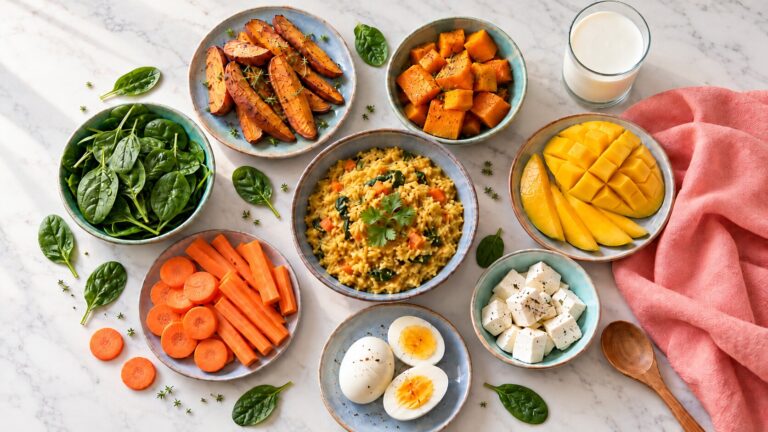
A dairy-free diet can provide adequate calcium. Vegetarian options like ragi porridge, tofu, moringa, and sesame can provide 260 mg of calcium in an entire day.
- For children ages 1 to 2, calcium can also be introduced through fortified soy milk. For an older infant, however, fortified soy milk is better unsweetened and fortified with calcium and Vitamin D.
- For infants, weaning foods can be tailored to medical nutrition and speciality dietary needs.
- Based on WHO guidance, weaning can begin as early as 6 months. At 6 months, infants entering the 1- to 2-year age range rely on food and nutrition to support their growth.
Safety Rules Before Introducing Calcium-Rich Foods
- Introduce one new food at a time.
- Wait at least two to three days before adding another allergen.
- Avoid whole nuts, whole seeds, hard cubes, and sticky dried fruits.
- Always use puree, mash, or very soft finger foods.
- Try to avoid added sugar and excess salt.
- Do not use cow’s milk as a drink before 12 months.
- Get in touch with a paediatrician if there are concerns about allergies, poor growth, or feeding refusal.
WHO notes that complementary feeding begins around 6 months because breast milk or formula alone no longer meets all nutrient needs. This period continues up to 23 months, so texture and food variety should improve gradually.
Conclusion
Calcium-rich foods for infants need to be soft, safe for their age, and easily digestible. Start with simple options like plain dahi, ragi kanji, dal, and soft tofu.
Both moringa and sesame can be introduced as further food options. Focus on food first, vitamin D support, and safe preparation. For allergies or poor growth, always follow paediatric guidance.





 No Refined Sugar
 No Preservatives
 No Maltodextrin